Wednesday, January 13, 2016

THE EARLY ART OF PATRIOTISM

At the close of the eighteenth century, the newly born United States of America was a place of unbridled opportunity and optimism.  Americans were beginning to grasp the potential of their Democracy, both as a beacon of freedom and a rising economic power.  Symbols of the new nation were all the rage from the flag forged in the fires of the revolution to the Great Seal of The United States, first used officially in 1782 .  The new nation was quickly epitomized by the symbol of the Bald Eagle.

Over the last two centuries the American Eagle has been portrayed in countless stylistic interpretations.  It is truly ubiquitous, appearing on everything from U.S. currency to Harley Davidson motorcycles. My very favorite interpretation of this patriotic symbol is the classic early 19th C. Federal eagle.  These examples often have gracefully curved spread wings and an open beak.  The quality of carving is often masterful, with paint
decoration and of course gilding. 


Carved eagles are truly works of art.  Skilled carvers could transform a block of pine or hardwood into a detailed three dimensional emblem of their nation.  Surfaces with thick quality gilding shine two centuries later as if they were solid gold.  We have two 19th C. eagles for sale in our January 16th auction.  I am asking for our bidders to do their patriotic duty and bid early and often on these wonderful works of art!

Monday, January 4, 2016

SAMURAI SWORDS

The fortunes of war have placed more Japanese Samurai Swords in the United States than in their country of origin.  Following Japan's surrender in 1945, the US military undertook a momentous task, the disarmament of the Japanese armed forces as well as the civilian population of the home islands.  The occupational forces scoured the country for military weapons, ordinance, aircraft, naval vessels and field gear.  All of Japan's military hardware was slated for orderly collection and destruction.  This regime of confiscation was conducted to pacify the potentially hostile population and prevent any continuing resistance by hard line military personnel.

This program went beyond demilitarization and included the Japanese civilian population.  The people of Japan were steeped in centuries of proud martial tradition. Many families descended from the Samurai class which had thrived in Japan for thousands of years preceding the Meiji restoration in 1868.  The vestiges of Samurai tradition resided in the homes of their descendants, most notably in the mythical and iconic Japanese sword.  Passed down through generations these magnificent and lethal works of art were cherished and honored.

In the 1930's the government of Imperial Japan launched a program to revive the martial spirit of Japanese society.  Propaganda glorified the Samurai tradition, the Samurai code of Bushido became the ideological manifesto.  Buddhist temples were closed in favor of state sanctioned Shintoism. The symbol of the warrior class was venerated again and given a prominent place in society, the traditional Japanese sword and its proud tradition was resurrected.  Forges were rekindled and sword making centers thrived once more.

Sword smiths tracing their lineage back hundreds  of years crafted masterpieces in the traditional manner and design.  Every officer in the Imperial Army and Navy carried a sword as a symbol of rank and martial status.  The quality of these modern Showa period swords varied dramatically from traditional hand forged blades to machine made examples, all appearing in period military mounts.  Some officer's preferred to carry ancient family blades in modern mounts, in a sense bringing their ancestral pride and tradition to war.

 
At wars end all of these weapons were confiscated by the occupying forces, many were destroyed, but many ended up in the duffle bags of soldiers and sailors returning home to the United States.  Today Japanese Samurai Swords are ubiquitous in the estates of our World War Two veterans.  As a result, the availability of these beautiful and iconic weapons has spawned a large and appreciative collector following in the United States.  


It is not uncommon to see Samurai swords offered at auction Today.  We are proud to have such an offering in our January 16th Art & Antiques Auction.  One sword has a blade dating to the Koto period.  It is a graceful beauty, with a tang signed by the smith who hand forged it over four hundred years ago.  It is housed in World War Two military mounts and carries a company grade officer tassel.  A family sword passed down through generations and carried by a high ranking Imperial Officer during the war.  Another sword crafted during the war accompanies it, it is also signed by a smith working during the Showa period in the proud tradition of his predecessors.  Both of these works of art are offered to the highest bidder with no reserve on January 16th.  See you at the auction.

For photographs and descriptions visit us at:  JJAMESAUCTIONS.COM

Friday, January 1, 2016

The Greatest Generation

In this business there sometimes seems to be a sea of interesting art antiques and curious objects lapping at the door.  These things can be described, measured, photographed, researched and dated.  This process helps us to understand them, to know what they are, maybe even affix a dollar value.  Unfortunately these objects usually appear out of context, without provenance their story is unknown.  Where they have been, who has possessed them or the role they have played is lost to time.  They are simply the sum of their parts and valued as such.  

On rare occasions an item or collection comes with a History, the story is intact!  Provenance can be the real value, whether a work of art or an antique.  One of these collections with a compelling story has crossed our threshold and will be offered to the highest bidder January 16th in J. James Auctioneers and Appraisers Winter Art & Antiques Auction.

The group consists of military documents, medals, a presented pocket watch, a US Naval Academy class ring, a cigarette case and finally a sword.  These diverse items have a common thread, they belonged to a decorated officer in the United States Navy who made the ultimate sacrifice in 1944.  USN Commander James Kent Averill was an aviator flying carrier based aircraft against a determined enemy in the Pacific.  

Averill's story begins with his graduation from the Naval Academy at Annapolis in 1927, went to war and served on USN aircraft carriers, U.S.S. Enterprise and the U.S.S.Yorktown.  He was part of a team of aviators which set a distance and speed record for the United States Navy, flying in formation from San Francisco to Honolulu in 1934. For this feat he was presented with a sterling silver cigarette case from the "WRIGHT AERONAUTICAL Co", commemorating the flight.


For his service, Averill was awarded the American Campaign Medal, Asiatic-Pacific Campaign Medal, WWII Victory Medal, American Defense Service Medal with Fleet Clasp, and the Legion of Merit.  He sadly perished on takeoff from the deck of a carrier, his body was never recovered.  A telegram and letter to his family sadly announcing this event are also included in the group.


The collection serves to tell his story.  It is a true opportunity for a World War Two Historian or collector to capture a glimpse into the lives of the men who fought and died in this war.  The collection maps out Commander James Kent Averill's life of service and ultimate sacrifice for his country.

Saturday, December 5, 2015

VINTAGE ICE


Diamonds seem to have a unique allure.  The sparkle is simply refracted light from crystalline surfaces polished and cut with artistic precision.  The stone is simply carbon born from billions of years of heat and pressure deep within the earth's mantel.  Diamonds are found in small deposits from Arctic Canada to Sub-Saharan Africa and although widely distributed globally, all diamonds are not equal.  Size, quality and cut determine value and the worth of these gemstones varies tremendously.

Our January 16th Winter Art and Antiques Auction offers a collection of vintage diamond jewelry of exceptional quality.  One piece however stands out from the crowd, it is a 1940's vintage round brilliant cut diamond set in gold.  What makes this diamond so special is a combination of quality and size.  This gemstone is a whopping 4.2 Carat weight!  It was purchased as an engagement ring by a Major League Baseball player with his World Series bonus.  


A stone of this size and quality is rare indeed and will be offered at auction.  Carbon born from the earth's crust over billions of years will grace hand of the highest bidder!

Monday, October 27, 2014

Pirate at the Table

September 19th is National Talk Like a Pirate Day!  This is definitely my favorite new make believe Holiday.  It is always fun to take on another persona and escape the workaday existence many of us lead.  Although my own life is sometimes mired in Mundania, in my work I am very fortunate. In the auction business, everyday is different, unique, a departure from the routine. 

I have very little control over what crosses our threshold and what I uncover in New England's stifling attics and musty basements.  Some days it is the rare and desirable, others it is just the flotsam and jetsam of objects from other (often deceased) peoples lives. But every day is different and every thing has a unique a story and connection.

I happened to be cataloging a piece from the Mayflower Society Collection which was fitting for September 19th.  A tavern table sat before me which may be the earliest example we have ever seen. The legs and base stretcher are elegantly vase and block turned oak. This ancient piece boasts a Queen Anne style carved apron and board top. The table shows the scars of three centuries, wear, scratches and what I just love to see, the small holes which indicate Powder Post Beetle damage.  This generally accompanies great age and often evidences a Cape Cod origin.

My mind begins to wander, could this piece have sat in the ancient Tavern at Point Jeremy in Welfleet.  It was a notorious haunt of the disreputable at the dawn of the 18th Century. Pirates were known to frequent this "bucket of blood". Buccaneers with Cape Cod ties include my favorite Samuel "Black" Bellamy, who lost his life as his Flagship the "Whydah" went down during a Hurricane in 1717.  Could Sam have sat at this table drinking rum and planning his next voyage?

Pirates seem to live in our collective imagination.  They were the original rebels and malcontents, living by their own code and often paying the ultimate price.  My imagination races to Nix's Mate, in Boston harbor.  It is an unremarkable pile of rocks which is visible only at low tide just outside the narrows.  This is the spot which the authorities hung gibbeted Pirates to rot and serve as a warning to all sailors shipping in and out of the port of Boston.  

Our auction on November 8th offers a rare opportunity to own this early 18th Century tavern table.  Pirate history aside this table truly speaks to you.  AAARHHHH Matey we hope to see you at the auction.

MASSASOIT

There is an item in our sale which you might call emblematic of the Pilgrim history.  It's inspiration stands on Cole's Hill looking over the harbor where the Mayflower lay at anchor Three Hundred and Ninety Four years ago. A larger than life bronze statue of the Wampanoag Chief Massasoit, by American Artist, Cyrus Edwin Dallin, (1861 - 1944). The statue was erected for the Pilgrim Tercentennial Celebration of 1920.  The figure is beautifully and gracefully executed, depicting Massasoit holding a peace pipe as if demonstrating his friendly intentions to the Pilgrims. 

Massasoit was indeed the truest and most constant friend to the first settlers of Plymouth colony.  The Wampanoag tribe under his leadership aided and protected the Pilgrims during their first tenuous years.  The natives taught the settlers New World farming techniques and educated them about the alien world they now inhabited.  In addition, Massasoit signed a military alliance with Governor Carver in 1621, ensuring his neutrality during the Pequot War in 1636.  He had a close tie to Edward Winslow, who nursed him while he was gravely ill.  One could say that early Plymouth Colony would have certainly failed without this native champion.


This bronze of Massasoit is quite rare.  It is a miniature of the statue on Cole's Hill and is signed at its base by the artist.  These beautiful works of art were sold to raise funds for the Tercentennial project and were given as gifts to dignitaries and supporters.  This example is in beautiful condition and is truly something to behold.  It has been deaccessioned by the Mayflower Society,  and will be offered without reserve at auction at our November 8th sale. Until then I'll see you at the auction!

Thursday, October 2, 2014

FOLLOW THE ARROW

The Horizon was endless and Parkman was gripped with a raging thirst. The hunt had lasted since dawn and the noon day sun was scorching everything beneath.  His fellow hunters seemed immune to the elements, their focus completely on their prey.  Out ahead of him, a figure on horseback was flanking the small heard of Bison.  The hunting party had picked up this trail at the stream while watering their horses.  They had followed it for hours across the featureless expanse of the open plains.

Parkman knew his friends back east would never understand.  His mind wandered to the glowing Brahmin parlors filled with men talking politics and money, neither existed out here, only the hunt.  He snapped back as Big Crow let loose a war whoop, made his approach, drew his bow and released.  The gigantic bull crashed to the ground with such force that his body plowed a furrow through the dark earth and then lay motionless in the dust. 

Parkman dismounted and joined his friend by the stone dead bison.  He could not see the wound which felled this magnificent creature.  Big Crow said a few words with eyes to the heavens, then smiled broadly as he turned to Parkman.  The tall Sioux hunter reached across the bison's massive wooly neck and drew out his arrow, which was buried up to the feathers.  Big Crow handed the arrow to Parkman and silently walked back to his pony.  

This is how I imagine it happened,  one hundred and sixty six years and half a continent away. The arrow lies on a table ready to be photographed for our November 8th auction.  Truly a survivor, mid-19th Century American Indian artifacts are very rare indeed!  It was crafted in the 1840's and used by a free band of Oglala Sioux, when they were still the undisputed masters of the Dakota plains.


This marvel of primitive aerodynamic engineering carries a ground iron tip, tied with sinew to a wooden shaft with feather fletching.  The shaft is true and terminates with a deep notch.  It is a thing of beauty, a fragile work of art executed with remarkable skill, but made for a deadly purpose, in war or on the hunt.  A faded and yellowing tag is affixed,  which reads:

"This arrow was presented to me by my cousin Francis Parkman in his house in Jamaica Plain a year or two before his death.  It is the one of which he speaks in "The Oregon Trail" as having been shot into a buffalo up to its feathers by the Sioux chief who pulled it out and gave it to Mr. Parkman.  David Greenough, March 1930."


Additional documentation accompanies this incredible rarity, which follows its journey through generations of Parkman's descendants to the present.  A photograph of the arrow appears in the book "The Oregon Trail" and the arrow itself will be available at auction to the highest bidder on November 8th, 2014. I look forward to seeing you at the auction!


Sunday, September 7, 2014

CORNERED

The simple corner chair sits before a white background ready to be photographed for our catalog.  It is a study of stark contrast, of wood turned ebony black from three hundred fifty years of oxidation.  Simple turnings with unassuming lines, pragmatic, humble, Spartan.  This beautiful simplicity was crafted in seventeenth century New England by a believer, created by a man who saw man's need for decoration as the sin of pride, decadence or simply unimportant when compared to his belief in god.  What he achieved is a masterpiece of understated design and straightforward utility.

Age has been kind to this simple chair.  It has survived hundreds of frigid New England Winters and stifling hot Summers, voracious insects, accidents, children, moves, poor attempts at preservation, even the late twentieth century mania of "restoration".  It is a survivor and remains a testament to another age.  The passage of time has worked gentle changes upon its honest frame.  The expansion and contraction of the wood has made its geometry wonderfully imperfect.  The top rail leans precipitously to the left, it sits a bit off kilter, the stretcher is uneven and the turnings are no longer spherical.  But it is a survivor!

This chair was created in the primitive woodworking shop of a colonial joiner or cabinet maker in the second half of the Pilgrim Century.  It is a contemporary of those courageous souls who risked all to build a new Jerusalem on the American shore.  It likely sat at a desk, its occupant busily writing or studying by candle light.  Could it have borne silent witness to the pursuits of an examiner at the Salem witch trials? Perhaps a Minister crafted his most inspiring sermon, or might it's owner have rested heavily in it after weeks in field fighting Indians?

This work of art would have been out of style by the early 18th Century.  American furniture began to adopt the refined lines and curved legs of the "Queen Anne" style.  Maple and Walnut were the preferred wood then, the turnings were executed in ring and vase design.  A Spanish foot would replace a simple straight leg.  More fashionable pieces may have relegated this simple chair to a back room or quiet corner.

This chair would have been a relic of another age by the time of the American Revolution.  It may have been viewed as a curiosity and was kept no doubt for nostalgic family attachment.  At the close of the 18th Century, American cabinet makers were building masterpieces.  Workshops turned out highly carved pieces with beautiful proportions bringing the English Chippendale style to American homes in exotic Mahogany.   

By the 19th Century the corner chair had run its course.  There have been many reproductions of early styles, but no innovation or original design for any broad market. By the second half of this century, furniture would become mass-produced and machine made.  It would devolve into a mix of many styles, with no clear form.

This  remarkable chair is a  survivor.  I wonder at how many examples of Pilgrim century furniture exist Today.  A rare opportunity is at hand, you could be the next chapter in the story of this simple chair, what will the twenty first century hold for it? Please join us and it on the eighth of November for the Mayflower society auction.  Until then I'll see you at the auction.

Friday, September 5, 2014

THE MAYFLOWER HOUSE

Once in a while an event comes along which is truly unique, in this case you could call it the ultimate house call.  J. James Auctioneers & Appraisers has been invited to conduct the select museum deaccession of the Mayflower Society House, in Plymouth, Massachusetts.  

Upon my initial tour of the beautiful Georgian mansion of Edward Winslow, I was struck by the incredible diversity of objects it held. The collection begun in 1946 encompasses three centuries of art and antiques and represents nearly every possible category in collecting.  Many of the items are of extreme rarity, even unique and they will be offered for sale at auction, November 8th, 2014.

We have begun the work of researching and cataloging this collection in detail.  This process lets us "live" with each piece for a time.  I am always impressed by certain items which speak to me, figuratively of course.  They may not be the rarest or certainly the most valuable, but they posses a history or quality which draws one in a bit closer.  These objects seem to transcend the material world and make one contemplate  a deeper meaning.
  This week a simple silver spoon has made an impact on this humble auctioneer.  It was created in Boston during the second half of the Seventeenth Century and bears the date 1685 with its owners monogram pounced.  This piece has all of the characteristics we love, it is a "Trefid" design with a rat tail back and a deep circular bowl.  It would have been a cherished piece and a mark of wealth and distinction for its owner.  It was crafted of coin silver, by a master silversmith,  in a relatively primitive workshop.  It is a masterpiece, the simplicity of design carries an authentic grace and beauty which compliments its rarity.


I sometimes indulge in a bit of fantasy when I am working with a piece like this.  I try to imagine what was happening during its early life, what did this spoon witness?  The late seventeenth century was a tumultuous time in the colony of Massachusetts Bay.  The colonists had prosecuted a successful campaign against their Indian neighbors during King Phillips war, but were battling increasing resistance to the strict and heavy handed rule of the Puritan church.  Massachusetts was engaged in fierce economic competition with it's neighboring colonies, while coping with the aftermath of a destructive war.  It was a period of transition for the English colonies, a time for soul searching, rebuilding.  How did the owner of this spoon fit into this complex world?

As this project unfolds and our cataloging moves forward, I am excited to see what is next uncovered. I look forward to sharing this unique experience.  Until then I'll see you at the auction!


Tuesday, July 29, 2014

FLOOR ART

I have always enjoyed fine hand loomed rugs, they are truly works of art and can be appreciated as such. In the antiques business they are ubiquitous, It seems like I see at least one on every house call.  I can see the beauty in an average late 20th Century Hamadan, or a coarsely woven Afghan, but all rugs are not created equal.  Occasionally I look down at my feet and see something spectacular.  Today my lowered gaze rested on an exceptional Antique silk prayer rug.  This masterpiece dates from the 19th Century and embodies hundreds of years of tradition, design and craftsmanship.  I instantly knew it to be a prayer rug, although it was not pointing to Mecca, it did have a point.

This beautiful rug was embellished with an intricate design and color choice which pointed to the Northern Caucasus, upon closer inspection, a rug from the Dagestan tribal region.  This fine example demonstrated quality in a very tight weave;  the knot count, north of 120 per inch.  I marveled at the complexity of the pattern and wondered at the hours which went into its creation.  As I beheld this masterpiece of weaving, I  noticed the edge of another rug peeking out just around the corner, my lucky day. 

My curiosity was rewarded by a bold blue field and geometric pattern surrounded by an intricate floral border it was another Caucasian prayer rug. This example, a Kuba carrying a design which can be traced to an individual village of Perpedil.
This beautiful work of art certainly showed its age, but was in remarkable condition.  My mind wondered to another time and place, when this rug would be delicately laid out, pointing in the direction of the Holy city of Mecca, its owner kneeling in rhythmic prayer and devotion.  The lives these works of art have lived, the history they carry make one think.
As I worked my way through this local home, I picked out six fine antique rugs altogether.  A massive Persian with an Islamic Calligraphy border was another favorite of mine as was a faded Afghan tribal. This fine collection was assemble over a century ago and therefore represents an extremely rare opportunity for the collector to own one of these fine Antiques.  These rugs will be offered for sale to the highest bidder on November 8th.  Until then, I look forward to seeing you at the auction!

Wednesday, July 16, 2014

ILLUSTRATING FINE ART

What a wonderful time to enjoy living in New England!  We wait all year for these fleeting months of Summer...pure Nirvana.  

Having wrapped up an excellent July 1st auction, we have set our eyes on our next event, our Fall Art and Antiques Auction, (date to be announced).  Some remarkable things have already darkened our sun drenched threshold.  While down on the cape chasing clambakes, cookouts and cold IPA's, I happened upon something simply amazing!  Let me begin by stating that illustrator Art is a true passion of mine.  My short list of great American Artists includes N.C. Wyeth, Howard Chandler Christie and Norman Rockwell, all famous art illustrators.  I have recently added a new name to that list.

I  walked into the dining room of a favorite consignor and beheld a portfolio of original early 20th Century pen and ink and watercolor illustrations by Harrison Cady.  These beautiful works of Art appeared in books written by Thornton Burgess, the two had a collaboration spanning five decades.  I fell in love with the simple innocence these images evoke, woodland creatures with human characteristics, a bear in overalls a mouse with spectacles and of course "Blackie the Crow" with his iconic top hat and scarf.  


These works of art have all of the hallmarks of an original creation, graphite dust smudges at the margins, mingle with the artist's casual pencil notations, the reverse with studio tags affixed identifying story boards and character plot lines.  This illustration collection represents a lost art, free hand creation, inky fingers and the smell of pencil lead. Not a computer involved, no design software, nothing digital at all, how did he manage?
 

These wonderful creations will be offered for sale to the highest bidder at our Fall auction.  Here lies a wonderful opportunity to add original art from an iconic American Artist to your collection. Make sure you are there to win them.  As always I look forward to seeing you at the auction!


Monday, April 7, 2014

MILITARIA SALE READY TO GO


I have been neglectful of this blog for the past two months and I sincerely apologize to my audience (of three). We have been absolutely dedicated with maniacal focus to cataloging this sale.  The work load of researching, vetting, photographing, measuring and describing in detail 400 very specialized lots was woefully underestimated by yours truly.  It was an absolute joy however and as we move to the next stage of the sale, the catalog (now available on our homepage) is one I am proud of.

This collection certainly offers some unique items of historical importance.  The uniform group once worn by Commodore Perry and his sword should be considered national treasures.  This man was a hero of the fledgling United States Navy, which faced the British during The War of 1812 and thrashed them soundly!  Omar Bradley's dress uniform is another headline grabber.  He was a five star general in command of over one million troops in Europe during World War Two. It is simply incredible to me, that these items are being offered for sale to the public.


The uniforms, hats, belts, boots and gear in this sale all represent something much larger than the materials and craftsmanship which went into their creation.  Although the collection covers over three centuries and many different countries, every piece shares an important quality, they are a testament to the brave men who used them.  A simple khaki service uniform worn by an infantry officer in 1918 during the horrors of trench warfare in Flanders, the Sword presented to a Confederate cavalry officer by his men during the battle Gettysburg,  or the uniform worn by a U-Boat petty officer while the battle for the Atlantic raged above, all represent the legacy of those who were willing to give their lives in service.

I am getting very excited as the date approaches,  this sale represents a rare opportunity and is simply thrilling to a militaria collector and enthusiast like me.  The crew is ready, the advertising in place, the catalog finished, all that is left is for you to join us on Saturday, April 26th at 11:00. I look forward to seeing you at the auction!

Sunday, February 23, 2014

BENEFIT TO CELEBRATE

It has been an exceptional couple of weeks at J.James Auctioneers and Appraisers.  There were three Winter Storms the last 14 days and I had a benefit Auction scheduled right between them!  I was fortunate enough to be invited to speak at the Plymouth Rotary Club luncheon.  After a brief presentation, we conducted a quick live auction to benefit my favorite local charity "Helping Hands of the Plymouth Animal Shelter".

After running around Town with my hat in my hand, we amassed a great selection of gift cards from some of my favorite local haunts,  our lots even included a tour and tasting at Mayflower Brewery and two spots at Plymouth's original Art Bar.  The generosity of our local business owners is unmatched in America's Hometown. I just love doing benefit events, everyone wins and I can mercilessly guilt people into opening their wallets.

We also added an important team member to our staff.  He is eight pounds and black as coal...our new Labrador Retriever George.  George will be working security at the auction and may lend a paw to help catalog.  George has all the wonder of a Puppy learning and exploring his world.  I am confident that he will grow to be an important member of our team.


The catalog for our April 26th Militaria Auction is growing daily.  We have over 130 lots photographed and described so far, with about 400 more on the way over the next few weeks.  The work load is tremendous, but we are truly having fun researching this stuff,  this sale will be epic!  I will be posting some pictures in my next Blog, until then, enjoy Winter in New England.


Monday, February 3, 2014

GO BUY A LOTTO TICKET!


I have an amazing, unprecedented and unsurpassed ability to schedule any event months in advance to coincide with a storm or major weather event.  Last March our sale was held in the face of a raging Nor'easter which became a Blizzard the night of our sale.  Tuesday evening, our auction was accompanied by another fierce Winter storm right on time.  During our preview, I glanced out the window and saw a small and lonely snowflake floating on a light and gentle breeze, two hours later it became sheets of white pushed by gale force winds.  I just love Winter!

When I took the stage at 6:00 I was greeted by the faces of some hearty New Englanders and I felt proud to be one.  My staff informed me that we had over seventy phone bids and even more left bids in the system.  Our attendance was less than half, but our empty seats had been converted into absentee bidders!  Although I still prefer the energy of a crowded auction, I knew with the help of technology, our bidders were still engaged.

As the snow laden winds howled outside Memorial Hall, the bidding heated up.  Jewelry was a particularly strong category, with my favorite piece, a Victorian Cameo Necklace fetching nearly three thousand dollars.  Our selection of Thai Silver Repousse was a true winner, with phone, internet and live bidding propelling these works of art to the stratosphere. I just love selling jewelry and silver, easy to move, store, ship and sell!

Militaria is a perennial  winner at our sales and it proved its popularity again.  Our Civil War Muskets went for all of the money and a rare WW2 German Helmet hammered at $1500.  The competition for militaria is red hot and I am excited to begin to catalog our April 25th and 26th Military sale! It is an amazing collection from a Museum which has been stored away for over twenty years.  The group spans three centuries and the globe.  I will be posting pictures and highlites of this sale every few weeks. 

Thursday, January 2, 2014

SOME LATE EDITIONS


I am getting excited for our January sale!  The new year has been born and I cant wait to see what treasures 2014 will yield.  Every day in this business is a little adventure, a treasure hunt, a glimpse into the past.  I have resolved for '14 to work harder, dig deeper and cast an even wider net to bring our customers the rare, the desirable and the beautiful.

We are putting the finishing touches on our exceptional Winter Art and Antiques Auction.  We have carefully selected lots to appear in our main line advertising and marketing pieces.  Our glossies are ordered, our lotting is finished and our catalog is proofed.  I leaned back in my chair in satisfaction and poured a Hennessy to toast when our phone rang.  A voice asked if there was time to add any consignments to our sale.  My instinct was to suggest our Spring sale and explain that January was now closed, but I couldn't help asking "What do you have?" The answer: "Some things from the Revolutionary War".  This sale is reopened!


As I entered the formal dining room of this ancient South Shore home, laid out on the table was a leather cartridge box, a cheesebox canteen and an absolutely amazing silk embroidered vest.  Now if I had a dime for every "Revolutionary War" item I have gone to see, I would be sitting on a Hawaiian Beach writing this, but upon closer inspection these three items are absolutely the genuine article, the real deal.  


The cartridge box although a bit rough is definatly period.  The canteen even has it's original red paint and its owners initials carved into the side.  Could these pieces have witnessed General Howe fleeing Boston under Washington's Guns?  Were they carried across the Delaware on that famous snowy night?  Sometimes I wish these things could speak and tell their stories.  The vest was truly something to behold.  Original 18th Century clothing is just as rare as it gets!  The silk was in an exceptional state of preservation and the embroidery was just stunning.  Covered in Delicate hand stitched flowers and foliate design, this vest would have put the "D" in dandy. It seems the New Year is getting off to a great start!

These three wonderful late editions are going to be offered for sale in our January 21st Sale, 6:00 PM at Memorial Hall, 83 Court Street, Plymouth MA.  See you at the Auction!

Monday, December 16, 2013

OLD GHOSTS

So many objects come through our doors, such a diverse variety it blows my mind.  The different uses and reasons for creation range from fine art, created for adornment and pure expression to weapons meant for warfare.  All of these objects have their own unique story to tell, since they cannot relate it directly, close observation and careful research can tease it out of the past.  Some things we can hold and truly feel an energy and history associated with them.   Antique Militaria is a category which truly exemplifies this phenomena.

An interesting collection of weapons and accoutrements will be featured in our January 21st Auction, ranging from a civil war Remington Zoave Rifle to an Early 19th C. British Bandsman's sword.  What truly draws my eye is a salty model 1841 Cutlass made by Ames Mfg Co for the United States Navy.  This piece has the look!  The hilt is brass with a grip made in a fish scale pattern, with numerical rack marks.  The blade is marked with a faint 1842 date.  Holding this piece can carry one back to the early days of the United States Navy.  Was this cutlass aboard a ship in the African squadron, running down slavers off of Sierra Leon?  Did it ride upon a blockade ship during the Civil War?  Was it in hands of a boarding party during the war with Mexico?  This piece truly speaks to you.


Another military piece which carries a compelling  history is the Model 1866 Allin Conversion Springfield Trapdoor.  These muskets armed our boys during the Indian Wars of the 1870's. They were lethal, but already obsolete when issued due to a single shot capacity.  I imagine this weapon griped  by a Pony Soldier fighting the Sioux.  Out on the barren plains, he would have been cursing it's limited capability in the face of an enemy armed with repeating rifles.

I have been working on a large lifetime collection of Militaria over the past few months, which we will feature in a specialty auction this Spring.  This amazing group spans both time and the continents, it includes everything from revolutionary war uniforms to one worn by an SS General during the second world war.  I will share some highlights in the coming weeks. Until then, Merry Christmas and a Happy New Year!

Wednesday, December 4, 2013

EVER WONDER

I absolutely love antique signs,  porcelain advertising signs, hand painted carved wood signs, street signs, posted signs, trade signs, loud signs and subtle signs.  I wonder at the art, what the written word evokes in the mind of its reader.  The symbolic aspect of signs is truly worth contemplating.  


There are several signs still in use Today which I absolutely covet.  One is attached to the building of a South Shore car dealer and has probably been there for seventy years,  it is the iconic Art Deco Pontiac logo in neon.  Another is a hotel sign which dates from the 1940's in East Greenwich Rhode Island.  It is part of a small town main street vista, which can act as a time machine if you look long and hard enough. This Neon flange sign advertises a lounge and weekly rates


  Signs have been with us for a very long time.  While visiting Pompeii and Herculaneum one can see the remains of painted signs on the ruins of the Ancient Roman equivalent of a strip mall.  18th and 19th Century signs often appear in the shape of the goods or services they advertise, to speak to the many illiterate potential customers.  I once owned an early painted French metal sign in the shape of a woman's shoe.  Early twentieth century porcelain signs demonstrate this art in high form.  These signs show the artistic potential, when color and design intersect.  I am always thrilled when an early porcelain sign crosses our threshold.


I sometimes wonder  how our sign resonates in the minds of people passing our business offices.  The day it was hung will always reside in my memory as both a moment of pride and anticipation.  Does our sign create a positive response?  Is it's message clear?  Did we get the color right?  I welcome you the reader to let me know.  Until then my hunt for early signs continues.  Please join us for our January 21st Auction, at 83 Court Street, look for the "Auction Today" signs out front.


Tuesday, November 26, 2013

AUCTION NIGHT NOVEMBER 19th

My favorite two aspects of my job are getting the stuff and selling the stuff, I guess that is my job when distilled and boiled down.  Auction night was a true success.  A large audience greeted me as I ascended the podium at six o'clock, with many familiar faces and some new as well.  I felt like the first couple of lots started us off a bit slow, as we had a flurry of left bids which won, but then the crowd kicked in and competition heated up the cold November air.

  The Plymouth specific antiques ignited interest with strong bids for the Indian Arrowheads and Antique Souvenir Porcelain.  The early Plymouth colony deed captured bids from the phone, floor and internet, before selling to a Cape Cod dealer.  Silver was another strong category.  Most of these glittering lots sold to the floor.  The large Dominick & Haff flatware set broke the $3500 mark, which I think will please our consignor!

I had a wonderful time bid calling and can't wait to do it again in January.  I would like to thank everyone who joined us for a great evening out, at America's Hometown Auction.  Thank you Chef Steve Coe of Bokx 109 for some truly amazing food and Bartending Service of New England for libations.  I am always grateful for my crew, which in my opinion is the best in the business.  I will see you all again January 21st, 6:00 P.M. at 83 Court Street.

Thursday, November 14, 2013

FIVE DAYS AWAY

Anticipation is the watch word of the week.  The catalog is completed, everything is tagged and carefully packed up.  The crew is confirmed, as is the chef and bartending service.  We are ready to go!  I love this week as it gives us time to reflect on over two months of accumulation.  I recall house calls from Boston to Truro,  the interesting people I have met and the precious objects which have joined our November 19th Lineup.  The hard work is complete, now the real fun begins.


We have over 260 lots of everything from 19th Century Kitchen Primitives, to Antique Georgian Silver and everything in between.  Paintings are strong in this sale, my personal favorite is Lot #1, a small 19th C. Oil on Canvas of a shipwreck dated '73 (1873).  We also have dozens of "organic" lots.  These are items from Plymouth, Massachusetts and New England, from wonderful 19th Century Primitives with Southern New Hampshire provenance, to a 17th Century Deed from a Cape Cod Indian Sachem.  The details of this important lot can be found in a fantastic story in the November 13th Edition of "The Old Colony Memorial", by Emily Clark.

READ ARTICLE HERE

  For the silver magnates, over 500 Ozt of Sterling silver spanning 200 years and many famous makers awaits their bid.  In this category a beautiful 19th Century flatware set by "Dominick & Haff" is a true standout, 90 pieces of over 150 Ozt Sterling Silver.  The true show stopper has to be the pair of British Silver Tea Caddies.  Hand chased, with ram finials, WOW!

Please join us for a wonderful night out, Tuesday, November 19th at 83 Court Street, Plymouth MA.  We have a great sale with Beer, Wine and food prepared by Chef Stephen Coe of BOKX109.  Competitive bidding and opportunity await.  See you at the auction!

Wednesday, November 6, 2013

THINGS THAT SPARKLE


One of my favorite forms of Art is jewelry.  It is a combination of metallurgy, nature and human artistic expression.  Something deep within our DNA attracts us to these objects of beauty.  Our eyes are drawn to gold, our pupils become fixated on a diamond's brilliance.  Is it the beauty both man made and natural which connect us to these objects, or do we just respond to things which sparkle?  For me antique and vintage jewelry hold a special allure.  Whether the ornate detail of a 19th C. Victorian Brooch, covered in mine cut diamonds, or the aerodynamic lines of a 1930's Art Deco Bracelet, I see the beauty.  

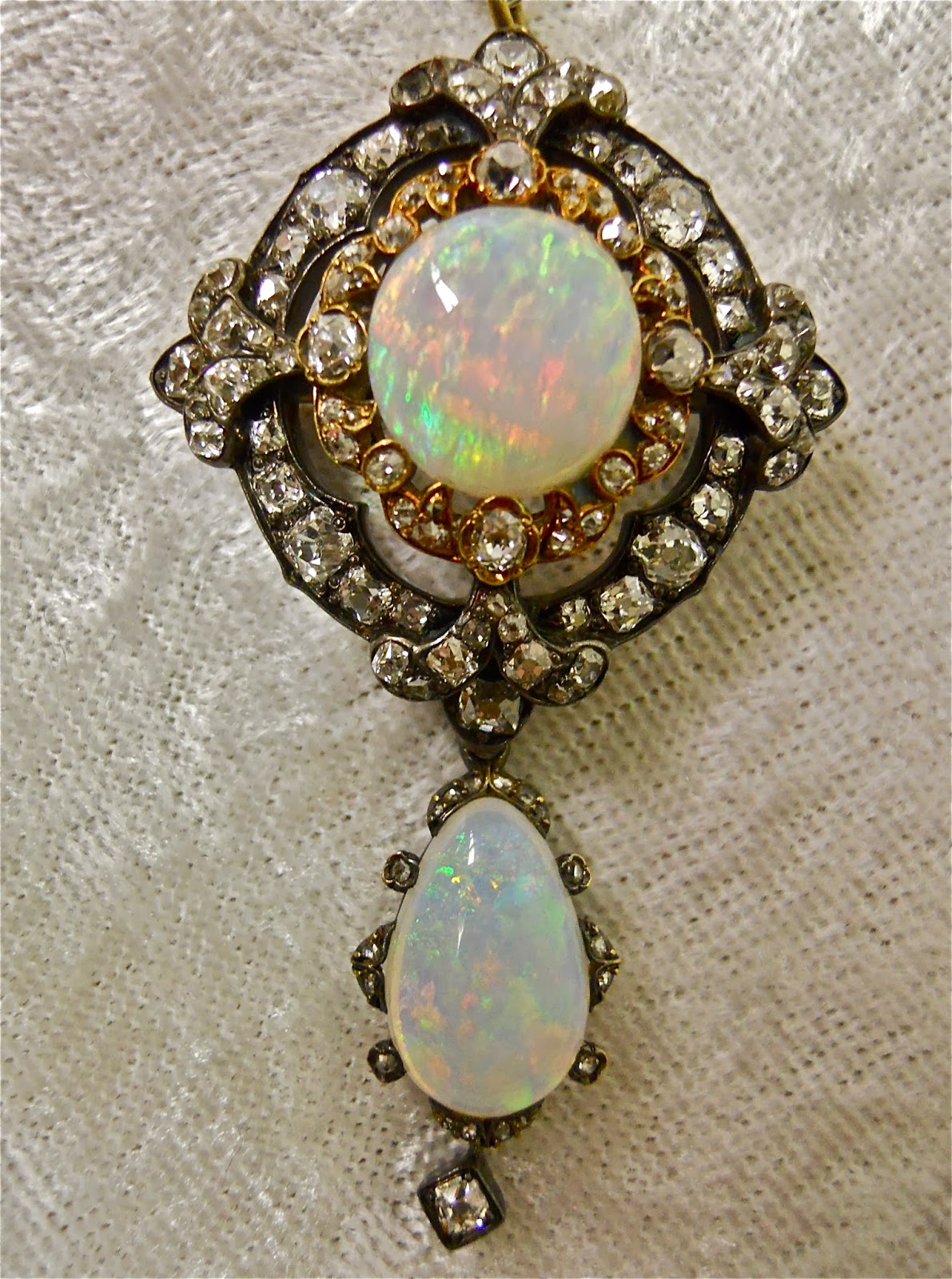
This week a call delivered an incredibly diverse collection of fine jewelry.  This group spans a century, from the 1890's to the 1990's, every piece has two common attributes: quality and beauty.  The first work of art presented, was a massive opal and diamond pendant dating from the early 20th C.  The center stone is a round cut Opal with sunrise colored fire, surrounded by over 4c of mine cut diamonds and another pear shaped stone suspended beneath.  Next came a three diamond ring, with stones that appeared to be internally flawless under the 10X of my loupe.  Both these pieces have been sent out for a full appraisal. 

My absolute favorite piece in this collection is an English, Victorian Cameo Necklace in it's original fitted box.  This piece consists of six hand carved Italian Shell Cameos set in 15K gold.  The quality and beauty of this piece is simply remarkable.  In total this call netted over thirty pieces of fine jewelry, which will be available to the highest bidder in our January 21st sale.